
Sapphire Optical Fiber High-Temperature Resistant Optical Transmission Solution


Detailed Diagram


Product Overview of sapphire fiber

Sapphire optical fiber is a high-performance optical transmission medium made from single-crystal aluminum oxide (Al₂O₃). Compared with conventional silica fibers, sapphire fibers exhibit outstanding mechanical strength, excellent thermal stability, and superior resistance to harsh environments such as high temperature, high pressure, and strong radiation.
Due to its unique physical and optical properties, sapphire fiber is widely used in extreme-condition sensing, infrared transmission, and high-temperature industrial monitoring applications where traditional fibers fail.
Key Features of sapphire fiber
1. Ultra-High Temperature Resistance
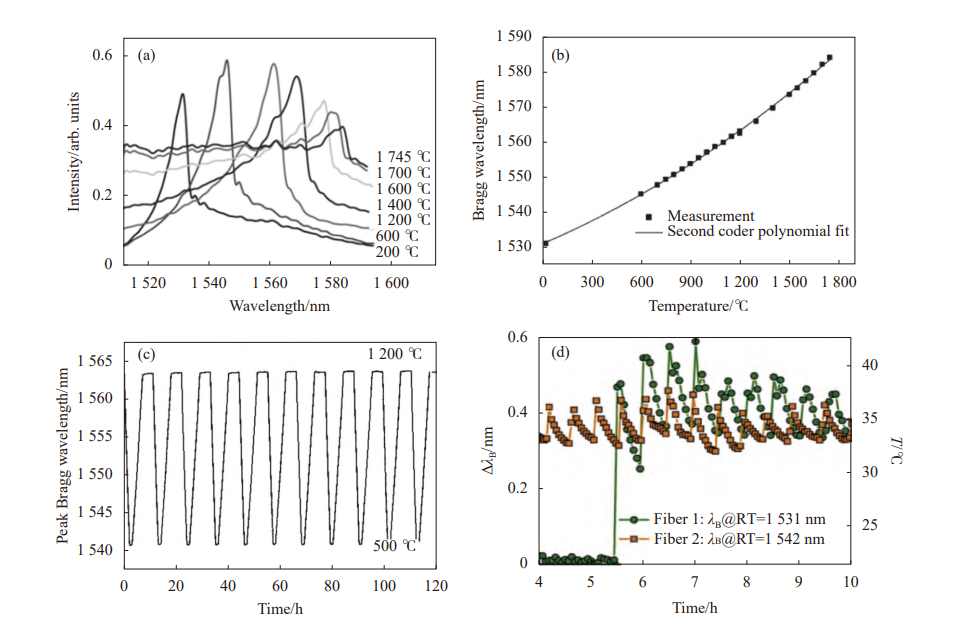
Sapphire fibers can operate in environments up to 1400°C (short-term) and 1000°C (long-term), making them ideal for extreme thermal conditions.
2. Excellent Mechanical Strength
Single-crystal structure provides superior hardness and wear resistance, ensuring durability in harsh environments.
3. Wide Infrared Transmission Range
Operating wavelength range typically covers 1300 nm to 2000 nm, suitable for infrared sensing and spectroscopy.
4. Low Transmission Loss
Optimized structure ensures transmission loss ≤ 2 dB/m @1550 nm, supporting efficient signal transmission.
5. Flexible Optical Design
Supports single-mode, few-mode, and multi-mode transmission, adaptable to different application requirements.
6. Customizable Parameters
Core diameter, cladding diameter, coating, and numerical aperture (NA) can be tailored to meet specific needs.
Technical Specifications of sapphire fiber
| Category | Item | Specification |
|---|---|---|
| Geometric Properties | Core Diameter | 5–20 μm (±1 μm) |
| Cladding Diameter | 100–250 μm (±1 μm) | |
| Coating Diameter | 200–350 μm (±1 μm) | |
| Optical Properties | Transmission Loss | ≤ 2 dB/m @1550 nm |
| Numerical Aperture (NA) | 0.3 – 0.5 | |
| Transmission Mode | Single / Few / Multi-mode | |
| Operating Wavelength | 1300 – 2000 nm | |
| Special Properties | Refractive Index Modulation | ≤ 0.015 |
| Temperature Resistance | ≤1400°C (short-term), ≤1000°C (long-term) |
Manufacturing Process of sapphire fiber
Sapphire optical fibers are typically produced using advanced crystal growth and fiber drawing techniques, such as:
- Laser Heated Pedestal Growth (LHPG)
- Edge-Defined Film-Fed Growth (EFG)
These methods ensure high crystal purity, precise dimensional control, and excellent optical uniformity. Post-processing steps such as polishing, coating, and precision cutting further enhance fiber performance.


Applications of sapphire fiber
1. High-Temperature Sensing
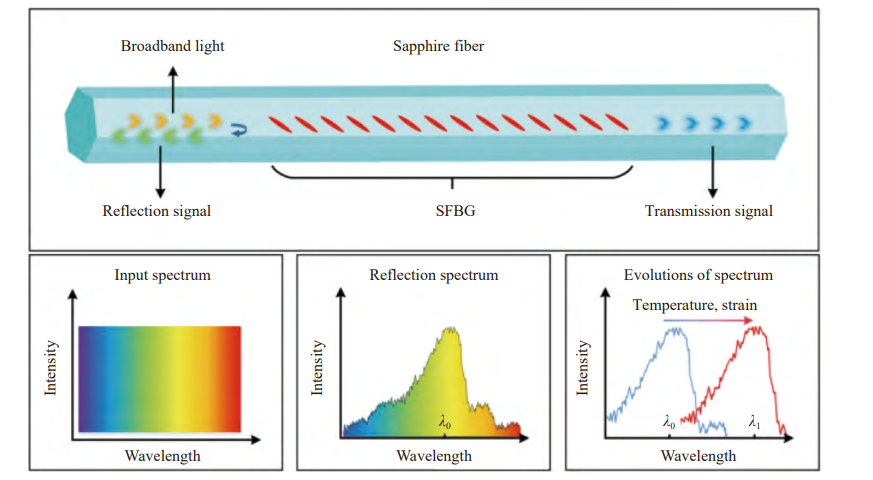
Used in aerospace engines, gas turbines, and industrial furnaces for real-time temperature monitoring.
2. Harsh Environment Monitoring
Suitable for nuclear reactors, chemical processing plants, and oil & gas exploration.
3. Infrared Optical Systems
Applied in infrared spectroscopy, thermal imaging, and optical diagnostics.
4. Combustion Diagnostics
Used in flame detection and combustion analysis systems.
5. Military & Aerospace
Ideal for guidance systems and sensing under extreme conditions.
FAQ of sapphire fiber
Q1: Can sapphire optical fiber be customized?
Yes, parameters such as core diameter, cladding size, coating type, and NA can be customized based on application requirements.
Q2: What is the typical transmission loss?
The transmission loss is typically ≤ 2 dB/m at 1550 nm, depending on fiber structure and quality.
Q3: Is sapphire fiber suitable for long-distance transmission?
It is mainly designed for harsh environments rather than long-distance communication due to higher loss compared to silica fiber.
Q4: What coating options are available?
Different coatings can be applied for protection, including high-temperature resistant coatings.
Q5: What industries use sapphire optical fibers?
Aerospace, energy, petrochemical, military, and scientific research industries commonly use sapphire fibers.
About Us
XKH specializes in high-tech development, production, and sales of special optical glass and new crystal materials. Our products serve optical electronics, consumer electronics, and the military. We offer Sapphire optical components, mobile phone lens covers, Ceramics, LT, Silicon Carbide SIC, Quartz, and semiconductor crystal wafers. With skilled expertise and cutting-edge equipment, we excel in non-standard product processing, aiming to be a leading optoelectronic materials high-tech enterprise.
Related Products
-

Custom Sapphire Optical Window 222mm × 74mm × 4...
-

Optical Sapphire Window components manufactured...
-
Transparent sapphire tubes pipes rods high temp...
-

Lens Prism Optical Glass DSP Custom Size 99.999...
-

sapphire optical windows High transmission Dia ...
-
3inch Dia76.2mm sapphire wafer 0.5mm thickness ...