
What Is a Beam Flux Monitor? How BFM Improves MBE Growth Accuracy and Repeatability
Precise control of material flux is one of the most important requirements in Molecular Beam Epitaxy.
Even if substrate temperature and vacuum conditions remain stable, variations in the intensity of an atomic or molecular beam can change film thickness, composition, doping concentration and interface quality.
For this reason, many MBE systems use a Beam Flux Monitor, or BFM, to measure and calibrate the intensity of material beams before and during epitaxial processing.
What Does a BFM Measure?
A Beam Flux Monitor indirectly determines atomic or molecular beam intensity by measuring Beam Equivalent Pressure, commonly abbreviated as BEP.
BEP provides a practical indication of the amount of source material reaching the substrate region.
By comparing beam-equivalent-pressure measurements from different sources, MBE operators can adjust source temperatures, valves and other parameters to obtain the desired flux ratio.
This is particularly important for compound semiconductors where the relative supply of different elements directly affects stoichiometry and crystal quality.
The Core of a Beam Flux Monitor
A typical BFM incorporates a Bayard–Alpert-type ionization gauge.
The detector can be installed on a linear-motion mechanism, often using a bellows assembly, so that it can move between a measurement position and a standby position.
During calibration, the detector is moved close to the substrate growth position.
This allows the monitor to measure the molecular beam under conditions that closely resemble those experienced by the actual wafer.
Once calibration is complete, the detector can be withdrawn from the beam path.
This movable configuration helps prevent unnecessary long-term exposure of the gauge to source materials, reducing contamination and extending the usable lifetime of the monitoring system.
How Does Beam Flux Measurement Work?
The operating principle is based on ionization.
Inside the ultra-high-vacuum chamber, electrons generated by the ionization gauge interact with atoms or molecules in the incoming beam.
Some of these particles become ionized after electron collisions.
The resulting ions generate a measurable electrical current.
Under suitable operating conditions, the measured ion current is related to the density of particles in the molecular beam.
A stronger beam therefore produces a larger response from the detector.
This allows the BFM to act as a quantitative tool for comparing and calibrating different source fluxes.
Why Beam Flux Control Matters in MBE
MBE growth depends on a carefully controlled relationship between substrate temperature, growth time and source flux.
For III-V semiconductor epitaxy, the flux ratio between Group III and Group V elements can have a particularly strong influence on surface structure and material quality.
If the beam flux is too low, the intended growth rate or composition may not be achieved.
If the flux is too high, excess material may change surface reconstruction, increase desorption-related effects or create unwanted defects.
Accurate flux calibration allows operators to establish a reproducible process window before actual epitaxial growth begins.
Improving Composition Control
For ternary or quaternary compound semiconductors, controlling beam flux becomes even more important.
The final alloy composition depends directly on how much of each constituent element is incorporated into the growing crystal.
Small variations in individual source fluxes can shift alloy composition and consequently change important electrical or optical properties such as bandgap, lattice constant and carrier behavior.
BFM measurements therefore provide an important reference for adjusting source conditions and maintaining consistent material composition.
Supporting Process Repeatability
One of the major challenges in epitaxial manufacturing is reproducing the same material structure from one growth run to another.
Source conditions can gradually change as material is consumed, source geometry evolves or thermal conditions drift.
Regular BFM calibration helps identify these changes.
Before growth, operators can measure the actual beam flux and compensate for deviations by modifying the source temperature or valve position.
This reduces dependence on source temperature alone as an indirect indication of evaporation rate.
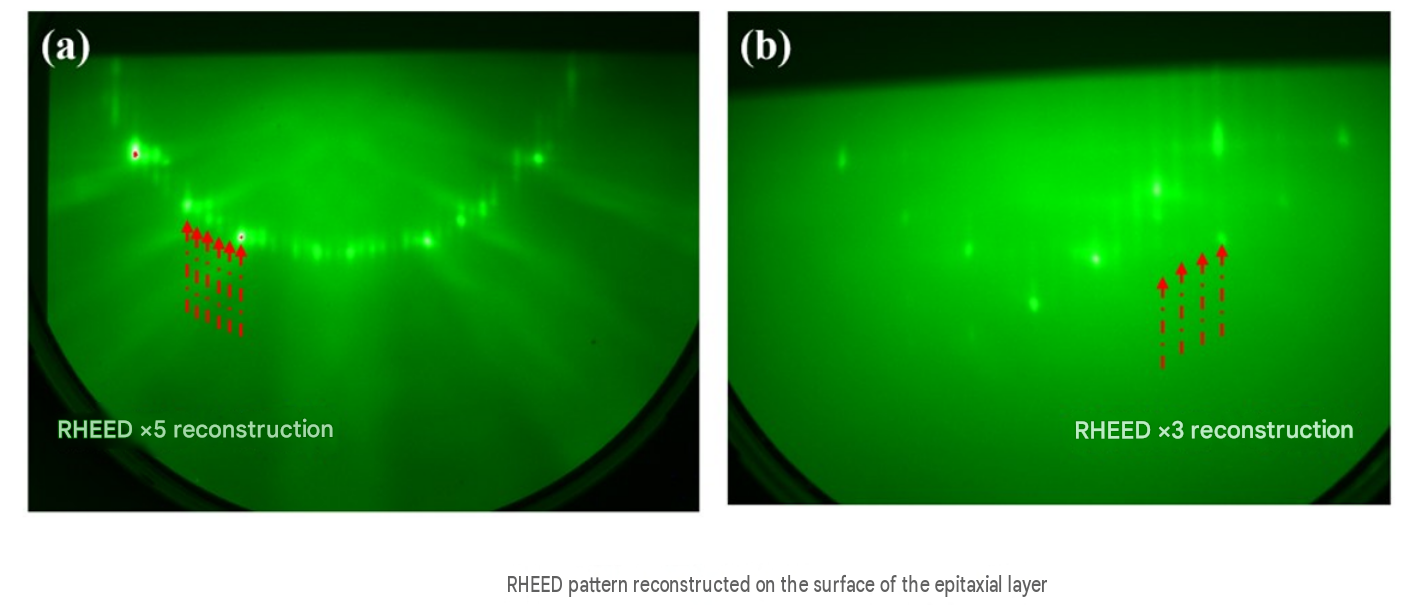
BFM and RHEED: Two Complementary Monitoring Technologies
BFM and RHEED perform very different but complementary roles inside an MBE system.
BFM measures what is being supplied to the substrate by evaluating the incoming molecular or atomic flux.
RHEED monitors how the substrate surface responds to those incoming materials by observing crystal structure, surface morphology and growth dynamics.
Together, the two systems provide a more complete picture of the epitaxial process.
BFM helps answer the question, “How much material is arriving?”
RHEED helps answer, “How is the crystal growing?”
By combining precise beam calibration with real-time surface monitoring, MBE systems can achieve the high level of growth control required for advanced semiconductor materials and heterostructures.
For both research and production environments, BFM is therefore much more than a vacuum gauge. It is a key process-control tool for improving composition accuracy, crystal quality and run-to-run repeatability in molecular beam epitaxy.
Post time: Aug-28-2026