
How RHEED Enables Real-Time Monitoring During Molecular Beam Epitaxy
One of the most powerful advantages of Molecular Beam Epitaxy is the ability to monitor the crystal surface while the epitaxial layer is actually growing.
Reflection High-Energy Electron Diffraction, better known as RHEED, is one of the most widely used in-situ characterization techniques for this purpose.
RHEED provides real-time information about surface crystallography, surface morphology, reconstruction and growth dynamics without significantly interfering with the molecular beams arriving at the substrate.
How RHEED Works
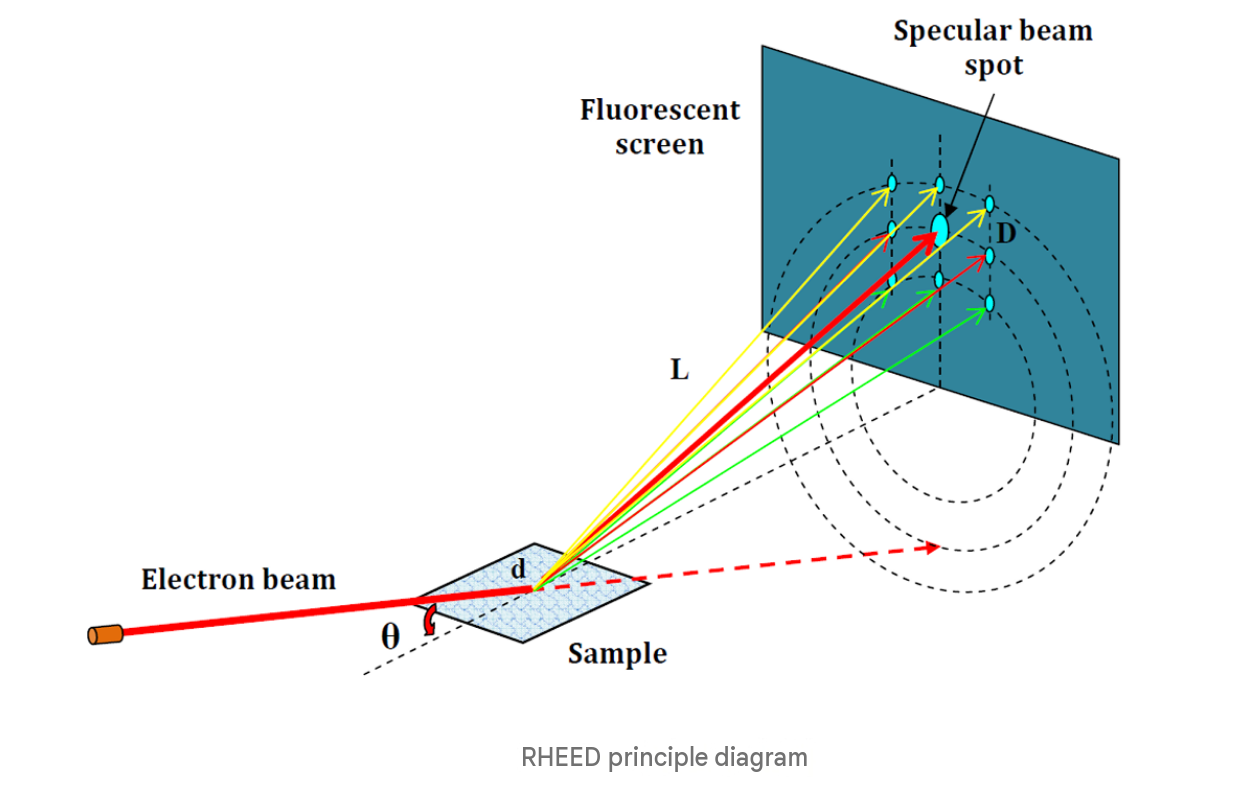
In a typical RHEED system, a high-energy electron beam with an energy of approximately 5–50 keV is directed toward the sample at a very small grazing angle, commonly around 1–2 degrees.
Because the electrons approach the sample almost parallel to the surface, they primarily interact with only the uppermost atomic layers.
This strong surface sensitivity makes RHEED particularly suitable for epitaxial growth monitoring.
At the same time, the grazing geometry allows the molecular or atomic beams from the MBE sources to continue reaching the substrate without major obstruction.
From Crystal Surface to Diffraction Pattern
When the electron beam interacts with the periodic atomic structure of the crystal surface, elastic scattering occurs.
Constructive interference appears along specific directions determined by the surface lattice.
In reciprocal space, diffraction occurs where the reciprocal lattice intersects the Ewald sphere.
The resulting diffraction pattern is projected onto a fluorescent screen, where it can be observed in real time.
From this pattern, researchers can obtain valuable information about surface symmetry, lattice spacing, reconstruction and surface morphology.
What Do RHEED Streaks Mean?
A smooth epitaxial surface often produces streak-like RHEED patterns.
When the growing film has an atomically flat, two-dimensional surface, its reciprocal lattice has a rod-like structure.
The intersection between these reciprocal-lattice rods and the Ewald sphere produces characteristic streaks on the fluorescent screen.
Sharp and narrow streaks generally indicate a highly ordered and relatively smooth surface.
For this reason, streak-like RHEED patterns are commonly associated with high-quality two-dimensional epitaxial growth.
What Do RHEED Spots Mean?
When the epitaxial surface becomes rough or develops three-dimensional islands, the diffraction pattern changes.
Instead of behaving like an ideal two-dimensional lattice, the surface begins to exhibit characteristics associated with three-dimensional structures.
The reciprocal-space features become more discrete, producing spot-like diffraction patterns when they intersect with the Ewald sphere.
A transition from streaks to spots can therefore indicate that the growth mode is changing from smooth layer-by-layer deposition toward three-dimensional island formation.
This makes RHEED a valuable tool for detecting changes in surface morphology during growth.
RHEED Intensity Oscillations and Monolayer Growth
RHEED can provide more than a static diffraction image.
The intensity of a selected diffraction feature may oscillate during layer-by-layer epitaxy.
When a complete atomic layer is formed, the surface becomes relatively smooth and RHEED intensity increases.
As atoms begin forming islands for the next layer, surface roughness increases and the diffraction intensity decreases.
As those islands spread and merge into another complete layer, the surface becomes smooth again and the intensity recovers.
This repeated cycle produces RHEED intensity oscillations.
By analyzing the oscillation period, researchers can estimate the epitaxial growth rate and, under suitable growth conditions, track film formation at approximately the monolayer level.
Monitoring Surface Reconstruction
RHEED is also highly sensitive to surface reconstruction.
Surface reconstruction occurs when atoms at the surface rearrange into a structure different from the atomic arrangement inside the bulk crystal.
These reconstructed structures can change significantly depending on substrate temperature, elemental flux and surface composition.
For III-V semiconductors, for example, changes in Group V flux or substrate temperature can produce distinct reconstruction patterns.
Because of this sensitivity, RHEED is frequently used as an indicator for optimizing growth conditions.
RHEED Before Epitaxial Growth
RHEED can also be used before deposition begins.
During substrate preparation, changes in the diffraction pattern can help determine whether native oxides or other surface species have been removed.
This is especially important because a clean, well-ordered substrate surface is a fundamental requirement for high-quality epitaxy.
During buffer-layer growth, RHEED can further help identify changes in surface configuration and assist with selecting suitable temperatures for subsequent layers, including superlattice structures.
Why RHEED Remains Essential for MBE
MBE operates under ultra-high vacuum and often involves atomic-scale changes that cannot be directly observed using conventional optical methods.
RHEED transforms those changes into a visible diffraction pattern that can be interpreted while growth is taking place.
It therefore acts as a real-time window into the epitaxial surface.
From identifying smooth two-dimensional growth to detecting island formation, measuring growth rates and monitoring surface reconstruction, RHEED remains one of the most important process-monitoring technologies in modern molecular beam epitaxy.
Post time: Aug-26-2026