
Black Quartz Glass: A Specialized Material for Radiation Absorption and Thermal Management
Black quartz glass is a specialized quartz material developed for applications where optical absorption, thermal radiation management, and high-temperature stability are more important than light transmission.
With its deep black appearance and high radiation absorption capability, black quartz is increasingly used in semiconductor, photovoltaic, infrared heating, laser protection, and other demanding thermal-processing environments.
Why Is Black Quartz Black?
Black quartz is essentially opaque and is produced by precisely introducing functional components into quartz raw materials.
Materials such as elemental silicon or TiO₂ can be used as controlled dopants. These components create a specialized microstructure that increases optical absorption across selected wavelength ranges.
Instead of transmitting or strongly reflecting incident radiation, black quartz absorbs it.
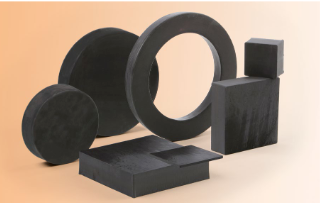
High Optical Absorption
Black quartz has a high optical absorption rate. Some products with a thickness of approximately 3 mm can absorb more than 95% of radiation from the ultraviolet to the mid-wave infrared range.
This property makes black quartz particularly useful in systems where uncontrolled reflected radiation could negatively affect thermal or optical performance.
Potential applications include:
- Semiconductor thermal-processing equipment
- Photovoltaic heating systems
- High-power infrared heating systems
- High-temperature shielding plates
- Wafer supports
- Heating-element covers
- Laser and intense-light protective covers
- Light-blocking components for optical systems
 Black Quartz and Thermal Management
Black quartz combines several useful characteristics:
- High optical absorption
- High thermal emissivity
- Relatively low thermal conductivity
- Excellent high-temperature performance
Its thermal conductivity is approximately 1.65 W/(m·K), which remains relatively low compared with metals and many structural materials.
The material can absorb incident radiation and redistribute energy through thermal re-radiation. This behavior can help improve temperature uniformity and reduce localized hot spots in high-temperature equipment.
High-Temperature Performance
Black quartz can offer excellent temperature resistance.
For certain specially doped black quartz materials, the softening point can reach approximately 2,000°C.
This makes specially engineered black quartz suitable for components exposed to intense thermal radiation and extreme temperatures, including heating-element covers, shielding plates, and wafer-support structures.
Actual temperature performance depends on the quartz composition, dopant system, manufacturing process, component geometry, and operating environment.
How Is Black Quartz Manufactured?
Black quartz is manufactured by precisely adding functional coloring or light-absorbing components to quartz raw materials.
The material is then processed through electric fusion or sintering under a specially controlled atmosphere.
Manufacturing parameters such as dopant composition, processing temperature, and furnace atmosphere must be carefully controlled to achieve:
- Stable black appearance
- High optical absorption
- Consistent thermal properties
- Reliable high-temperature performance
Black Quartz vs. Clear and Milky Quartz
The three materials have fundamentally different roles.
Clear quartz is designed for high light transmission and optical applications.
Milky quartz uses internal microbubbles to scatter and reflect infrared radiation, making it suitable for thermal insulation.
Black quartz absorbs radiation and converts the absorbed energy into thermal energy, making it suitable for thermal management and radiation protection.
Therefore, black quartz should be selected when radiation absorption and temperature uniformity are more important than optical transparency.
Choosing the Right Black Quartz
When selecting black quartz for industrial applications, engineers should consider:
- Required absorption wavelength range
- Optical absorption rate
- Thermal emissivity
- Operating temperature
- Material purity
- Component dimensions
- Dopant composition
- Surface quality
- Application-specific requirements
Black quartz does not have a single universal performance specification. Because application requirements vary significantly, products are often evaluated according to supplier specifications or customized technical requirements.
For demanding thermal-processing and optical applications, selecting the correct black quartz composition and manufacturing process is essential for achieving stable performance.
Post time: Aug-13-2026