
Silicon Carbide: From Abrasive Material to Next-Generation Semiconductor
When people hear the term silicon carbide (SiC), one of the first things that may come to mind is carborundum—the extremely hard material traditionally used in grinding wheels, cutting tools, and abrasives.
Thanks to its exceptional hardness, wear resistance, chemical stability, and ability to withstand high temperatures, silicon carbide has long been widely used in abrasives, refractory materials, grinding tools, and advanced ceramics.
In our previous article, we explored another fascinating side of silicon carbide crystals—their use as brilliant gemstone materials. This time, we will turn our attention to one of the most important modern applications of SiC: semiconductor technology.
Understanding Materials Through Electrical Conductivity
Materials are commonly classified as conductors, semiconductors, and insulators according to their electrical conductivity.
From a more fundamental perspective, however, their electrical behavior is determined by their electronic energy band structure, particularly the relationship between the valence band, conduction band, and band gap.
As illustrated in the energy band diagram, conductors, semiconductors, and insulators exhibit distinctly different band structures.
In conductors, the valence band and conduction band overlap or are partially filled. Electrons can therefore move relatively freely under an applied electric field, allowing electrical current to flow easily.
In semiconductors, the valence band and conduction band are separated by a finite energy gap known as the band gap. Electrons must acquire sufficient energy—through thermal excitation, light, or an electric field—to move from the valence band into the conduction band and participate in electrical conduction.
In insulators, the band gap is considerably larger, making it much more difficult for electrons to reach the conduction band under normal operating conditions. As a result, electrical conduction is strongly suppressed.
Therefore, the distinctive electrical behavior of semiconductor materials originates fundamentally from their energy band structures.
Energy Band Structure Diagram
From Silicon to Silicon Carbide
Semiconductor materials can be divided into elemental semiconductors and compound semiconductors.
Silicon (Si) and germanium (Ge) are well-known elemental semiconductors, while materials such as silicon carbide (SiC) and gallium arsenide (GaAs) belong to the category of compound semiconductors.
Germanium played an important role during the early development of semiconductor devices. Silicon later became the dominant semiconductor material because of its mature manufacturing technology, abundant raw materials, stable oxide formation, and excellent overall performance.
Today, silicon remains the foundation of the global semiconductor industry.
However, as power electronics continue to demand higher voltages, higher operating temperatures, higher switching frequencies, and greater energy efficiency, conventional silicon devices are increasingly approaching their material-related performance limitations.
This has accelerated the development of advanced semiconductor materials.
Among them, silicon carbide has emerged as one of the most important wide-bandgap semiconductor materials and a strong complement to conventional silicon technology, particularly in power electronics.
So, what makes SiC so attractive?
The Unique Crystal Structure Behind SiC Performance
Silicon carbide is a compound semiconductor composed of silicon and carbon atoms in a 1:1 atomic ratio.
Its crystal structure is based on tetrahedral bonding. Each silicon atom is bonded to four neighboring carbon atoms, while each carbon atom is bonded to four silicon atoms, forming strong Si–C bonds throughout the crystal lattice.
SiC can exist in numerous crystal structures, or polytypes, among which 4H-SiC is currently the most widely used for power semiconductor devices.
Atomic Structure of SiC
A material’s structure determines its fundamental properties, while those properties ultimately define its potential applications.
The strong chemical bonds and distinctive crystal structure of SiC give it a combination of electrical, thermal, and mechanical properties that are particularly valuable for high-performance semiconductor devices.
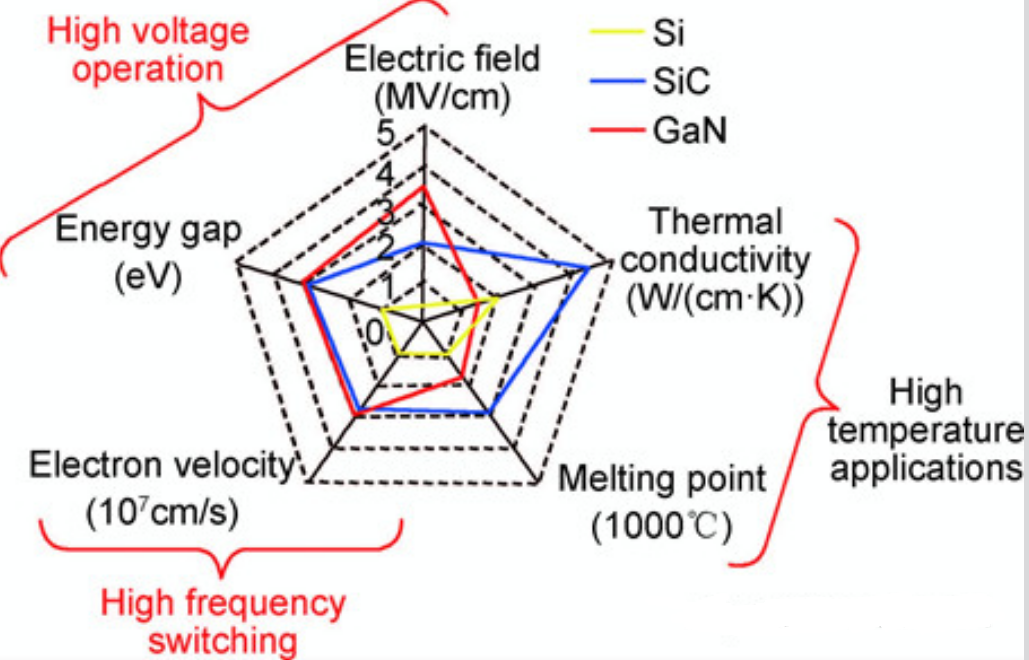
Three of the most important characteristics are its high critical electric field, wide band gap, and high thermal conductivity.
1. High Critical Electric Field
One of the major advantages of silicon carbide is its extremely high critical electric field, also commonly referred to as critical breakdown field strength.
Compared with silicon, SiC can withstand a much stronger electric field before electrical breakdown occurs.
This allows SiC power devices to achieve high blocking voltages while using thinner and more heavily doped drift layers. As a result, devices can achieve significantly lower on-resistance for a given voltage rating.
In practical terms, this enables the development of power devices that are smaller, more efficient, and capable of operating at much higher voltages than comparable silicon-based devices.
For applications such as electric vehicles, renewable energy systems, industrial power supplies, and high-voltage power conversion, this is a major advantage.
2. Wide Band Gap
Another defining characteristic of SiC is its wide band gap.
Band gap energy is commonly expressed in electron volts (eV), where:
1 eV ≈ 1.602 × 10⁻¹⁹ J
For 4H-SiC, the band gap is approximately 3.26 eV, compared with approximately 1.12 eV for silicon at room temperature.
Because of its wider band gap, SiC generates fewer intrinsic charge carriers at elevated temperatures. This allows SiC devices to maintain stable electrical performance under operating conditions where conventional silicon devices become increasingly difficult to use.
Together with materials such as gallium nitride (GaN), SiC is commonly classified as a wide-bandgap semiconductor.
These materials enable power electronic devices to operate efficiently under:
- Higher voltages
- Higher temperatures
- Higher switching frequencies
- Higher power densities
As a result, SiC-based power systems can achieve improved efficiency, reduced energy losses, smaller passive components, and more compact overall system designs.
3. High Thermal Conductivity
Thermal management is another critical challenge in semiconductor devices, particularly in high-power applications.
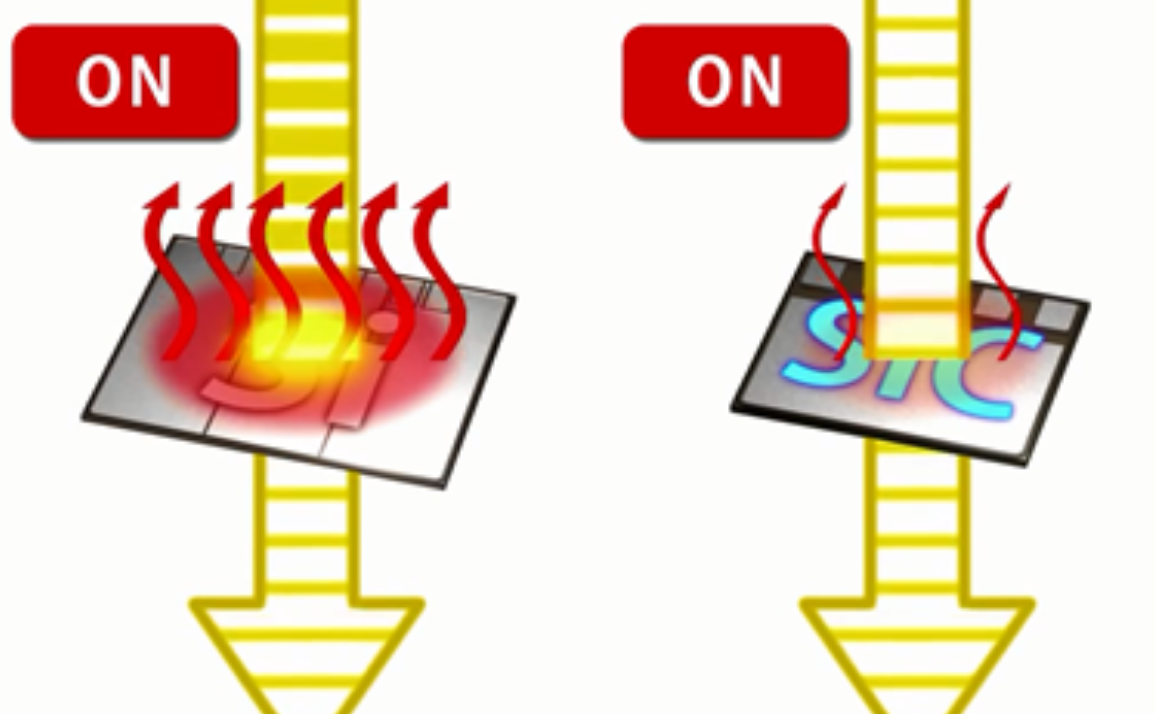
During operation, semiconductor components generate heat. If that heat cannot be efficiently removed, device temperature rises, potentially reducing performance, reliability, and service life.
Silicon carbide offers excellent thermal conductivity.
Depending on crystal quality, orientation, temperature, and measurement conditions, high-quality SiC exhibits thermal conductivity significantly higher than that of silicon. Representative values for SiC can exceed 400 W/m·K, compared with approximately 150 W/m·K for silicon near room temperature.
This excellent thermal performance allows heat generated within SiC devices to dissipate more efficiently.
Consequently, SiC technology can support higher power densities and more compact thermal management systems, which is especially valuable in applications where space, weight, and efficiency are critical.
Silicon Carbide as a Power Semiconductor Material
For more than a century, silicon carbide has been known as a highly durable material for abrasives, refractory products, grinding tools, and technical ceramics.
Today, however, one of its most important growth areas lies in power semiconductor technology.
SiC is increasingly used to manufacture advanced power devices such as:
- SiC MOSFETs
- Schottky Barrier Diodes (SBDs)
- Power modules
- High-voltage switching devices
The combination of a high critical electric field, wide band gap, high thermal conductivity, and strong chemical stability enables SiC devices to deliver excellent performance in demanding power conversion environments.
Typical applications include electric vehicles and charging infrastructure, photovoltaic inverters, energy storage systems, industrial motor drives, railway traction, data centers, smart grids, and high-voltage power supplies.
Compared with conventional silicon solutions, SiC technology can help reduce switching and conduction losses, increase switching frequency, improve system efficiency, and reduce the size and weight of power electronic systems.
As SiC crystal growth, wafer manufacturing, epitaxy, and device fabrication technologies continue to advance, silicon carbide is moving rapidly from a specialized material into a key platform for next-generation power electronics.
From a traditional abrasive material to an advanced semiconductor, SiC is demonstrating how the same extraordinary material properties can create value across entirely different industries.
And this may only be the beginning of the silicon carbide era.
Post time: Aug-18-2026