TFLN / TFLT Thin-Film Photonic Materials on Insulator

Detailed Diagram

Product Overview

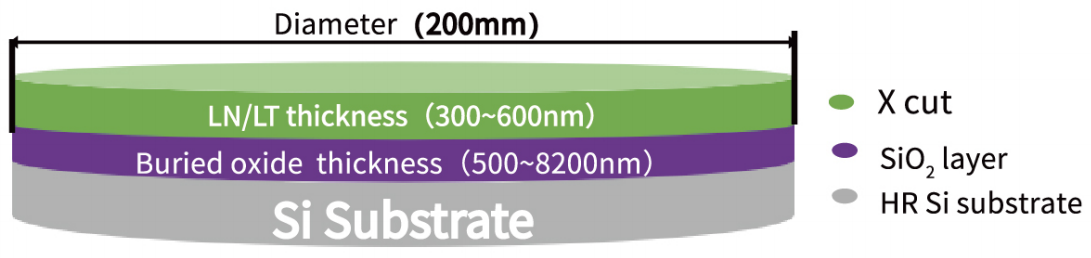
TFLN (Thin-Film Lithium Niobate on Insulator) and TFLT (Thin-Film Lithium Tantalate on Insulator) are high-quality single-crystal thin films fabricated on insulating substrates using advanced smart-cut (ion-slicing) technology. These materials combine the exceptional intrinsic properties of lithium niobate (LiNbO₃) and lithium tantalate (LiTaO₃) with the advantages of thin-film integration, enabling compact, high-performance photonic devices.
By integrating crystalline thin films onto insulating platforms, both TFLN and TFLT provide excellent optical confinement, low propagation loss, and compatibility with modern semiconductor fabrication processes, making them ideal for next-generation integrated photonics.
Key Material Characteristics
TFLN (Thin-Film Lithium Niobate)
- Outstanding electro-optic coefficient: r₃₃ ≈ 30–80 pm/V
- Strong second-order nonlinear effect (χ²)
- Ultra-fast modulation capability: 100 GHz+ bandwidth
- Low optical loss and high optical confinement
- Ideal for high-speed and quantum photonic applications
TFLT (Thin-Film Lithium Tantalate)
- Broader optical transparency range (especially in mid-infrared)
- High laser damage threshold: >500 MW/cm²
- Excellent thermal stability: dn/dT ≈ 1.5 × 10⁻⁵ /K
- Superior performance under high optical power conditions
- Strong suitability for harsh environments and high-energy systems
Working Principle
Both TFLN and TFLT operate based on their strong electro-optic and nonlinear optical effects:
- Electro-optic effect: External electric fields change the refractive index, enabling high-speed optical modulation.
- Second-order nonlinearity (χ²): Enables frequency conversion processes such as second-harmonic generation (SHG), sum/difference frequency generation, and entangled photon pair production.
- Waveguide confinement: Thin-film structure enhances light-matter interaction efficiency, significantly reducing device size while improving performance.
Applications
TFLN Applications
- High-speed optical modulators (100G / 400G / 800G communication systems)
- Integrated photonic circuits (PICs)
- Quantum optics (entangled photon sources, quantum frequency conversion)
- Microwave photonics
- Optical signal processing
TFLT Applications
- Mid-infrared sensing and spectroscopy
- High-power laser systems
- Acousto-optic (AO) and electro-optic hybrid devices
- Infrared imaging and detection
- Harsh-environment photonic systems
Comparison Summary
| Property | TFLN | TFLT |
|---|---|---|
| Electro-optic performance | Excellent | Good |
| Nonlinear efficiency (χ²) | Very strong | Strong |
| Transparency range | Visible–NIR | Extended to mid-IR |
| Laser damage threshold | High | Very high |
| Thermal stability | Good | Excellent |
| Core applications | High-speed & quantum photonics | Infrared & high-power systems |
FAQ
Q1: What is the main difference between TFLN and TFLT?
TFLN focuses on ultra-fast electro-optic modulation and quantum photonics, while TFLT offers better performance in mid-infrared applications and high-power optical environments.
Q2: Are these materials compatible with semiconductor fabrication?
Yes, both TFLN and TFLT are fully compatible with CMOS processes, enabling large-scale integration.
Q3: Can TFLN be used for quantum applications?
Yes, its strong χ² nonlinearity makes it ideal for generating entangled photon pairs and performing quantum frequency conversion.
About Us
XKH specializes in high-tech development, production, and sales of special optical glass and new crystal materials. Our products serve optical electronics, consumer electronics, and the military. We offer Sapphire optical components, mobile phone lens covers, Ceramics, LT, Silicon Carbide SIC, Quartz, and semiconductor crystal wafers. With skilled expertise and cutting-edge equipment, we excel in non-standard product processing, aiming to be a leading optoelectronic materials high-tech enterprise.